Programs Offered

The Department of Mechanical Engineering offers JNTUK-affiliated programs spanning undergraduate, postgraduate, and doctoral levels. The four-year B.Tech in Mechanical Engineering builds strong fundamentals in thermodynamics, design, manufacturing, and mechatronics, while the two-year M.Tech in CAD/CAM develops advanced expertise in heat transfer, IC engines, refrigeration, and computational fluid dynamics. A recognised Ph.D. research centre under Andhra University and JNTUK supports scholars across thermal, design, and manufacturing streams — preparing graduates for careers in automotive, aerospace, energy, manufacturing, and IT.

Our Programs

B.Tech — Mechanical Engineering

The Program Educational Objectives describe what graduates of our B.Tech Mechanical Engineering programme are expected to achieve within a few years of graduation. They guide curriculum design and align our outcomes with industry expectations and the needs of society.

  • To educate the graduate of the program to build a successful technical or professional career in Mechanical Engineering.
  • To envisage graduate engineer to achieve the goal in terms of pursuing higher education and Research and Development activities.
  • To help graduates become a moral & ethically responsible citizen in nation building.

Program Outcomes capture the knowledge, skills, and professional attributes our graduates will demonstrate by the time of graduation. They are aligned with national accreditation standards and ensure preparedness for engineering practice in ME.

  • Engineering Knowledge: Apply mathematics, science, and mechanical engineering fundamentals to the solution of complex engineering problems.
  • Problem Analysis: Identify, formulate, review research literature, and analyse complex mechanical engineering problems.
  • Design & Development: Design solutions for complex problems and design components or processes meeting specified needs with appropriate consideration for public health, safety, culture, society, and environment.
  • Investigation: Use research-based knowledge and methods including design of experiments, data analysis and interpretation, and synthesis of information to provide valid conclusions.
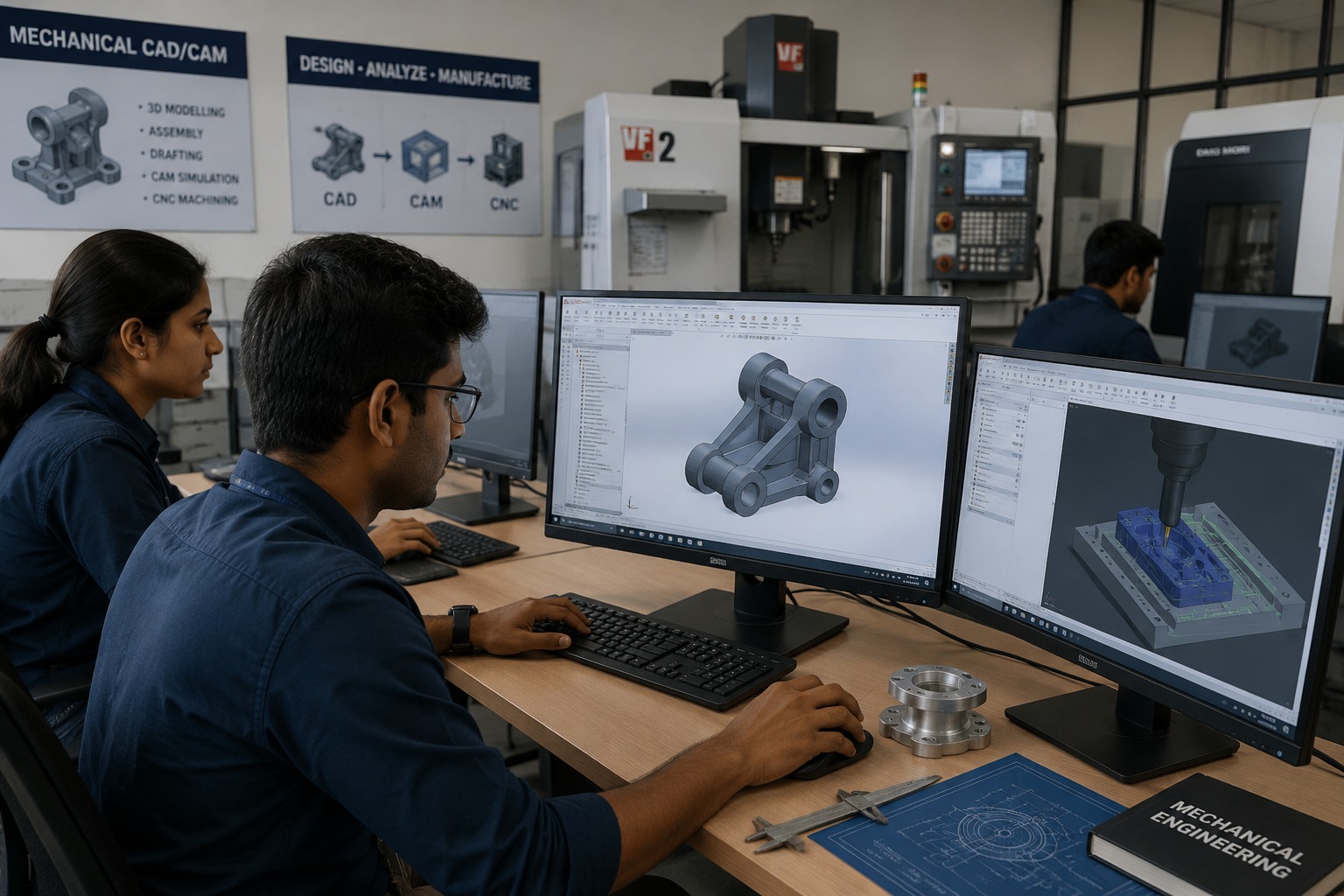
  • Modern Tools: Apply AutoCAD, SolidWorks, CATIA, ANSYS, Pro-E, MATLAB, and modern CAD/CAM/CAE tools to mechanical engineering problems.
  • Engineer & Society: Assess societal, health, safety, legal, and cultural issues relevant to professional engineering practice.
  • Sustainability: Understand the impact of engineering solutions in societal and environmental contexts and the need for sustainable development.
  • Ethics: Apply ethical principles and commit to professional ethics, responsibilities, and norms.
  • Teamwork: Function effectively as an individual and as a member or leader in diverse, multidisciplinary teams.
  • Communication: Communicate effectively through reports, design documentation, and presentations.
  • Project Management: Apply engineering and management principles to manage projects in multidisciplinary environments.
  • Lifelong Learning: Recognise the need for and engage in independent and lifelong learning amid technological change.

Program Specific Outcomes are the specialised competencies that distinguish our Mechanical Engineering programme — focused on design of mechanical and thermal systems and modern manufacturing practice.

  • Apply mechanical engineering fundamentals to design mechanical engineering systems and thermal systems.
  • Identify and select appropriate manufacturing processes and apply quality control methods for production of various components.

M.Tech — CAD/CAM

  • Graduates will be engineering practitioners and leaders, who would help solve industry's technological problems.
  • Graduates will be engineering professionals, innovators or entrepreneurs engaged in technology development, technology deployment, or engineering system implementation in industry.
  • Graduates will function in their profession with social awareness and responsibility.
  • Graduates will interact with their peers in other disciplines in industry and society and contribute to the economic growth of the country.
  • Graduates will be successful in pursuing higher studies in engineering or management.
  • Graduates will pursue career paths in teaching or research.

Our M.Tech program outcomes ensure that graduates demonstrate advanced analytical, design, and research capabilities — meeting AICTE guidelines and the expectations of industry, PSUs, and research institutions.

  • Having an ability to apply mathematics and science in engineering applications.
  • Having an ability to design a component or a product applying all the relevant standards and with realistic constraints, including public health, safety, culture, society and environment.
  • Having an ability to design and conduct experiments, as well as to analyse and interpret data, and synthesis of information.
  • Having an ability to use techniques, skills, resources and modern engineering and IT tools necessary for engineering practice.
  • Having problem solving ability- to assess social issues (societal, health, safety, legal and cultural) and engineering problems.
  • Having adaptive thinking and adaptability in relation to environmental context and sustainable development.
  • Having a clear understanding of professional and ethical responsibility.
  • Having a good cognitive load management skills related to project management and finance.

On completion of the M.Tech (CAD/CAM) programme, graduates will be able to:

  • Analyse, design and develop mechanical systems to solve complex engineering problems by integrating modern mechanical engineering tools, software and equipment’s.
  • Adopt a multidisciplinary approach to solve real-world industrial problems.
  • Independently carry out research / investigation to solve practical problems and write / present a substantial technical report/document.